Visit Museum of Illusions Brussels: Plan ahead
Museum of Illusions Brussels is a compact, self-guided attraction known for perspective rooms, optical displays, photo setups, and puzzles. Plan for about an hour rather than a half-day museum visit; lingering for photos or the Smart Playroom can stretch it to around 90–120 minutes. The experience is hands-on, and staff can help explain effects and take photos when available. One detail worth checking before you set out: the Brussels city centre has another similarly named illusion attraction, so confirm your ticket is for Rue du Fossé aux Loups 18. This guide covers timing, arrival, access, and ways to fit the visit into your day.
Quick overview: Museum of Illusions Brussels at a glance
The visit is a short, interactive indoor stop. Your experience depends more on taking part in the displays than on covering a large collection.
- When to visit: The museum is open 10am–6pm, with last entry at 5pm; it normally closes on Wednesdays outside Belgian school holidays. Weekends before noon are a good choice if you want more room for photos, while visitor reports suggest the rooms can feel tighter after about 12:30pm.
- Getting in: Standard adult admission is €17.50. Booking ahead is especially useful during school holidays, but a timed ticket does not guarantee immediate entry.
- How long to allow: Allow 45–90 minutes for the main visit; budget up to 120 minutes if you plan to take repeated photos or spend time on puzzles.
- What most people miss: Slow down for the explanations beside the illusions, then leave time for the Smart Playroom and brain teasers if you want more than a quick photo stop.
Jump to what you need
🕒 Where and when to go
🎟️ Which ticket is right for you?
🗺️ Getting around
📸 Illusion rooms and photo spots
♿ Facilities and accessibility
Where and when to go
How do you get to Museum of Illusions Brussels?
The museum is in central Brussels, beside De Brouckère station and within walking distance of Brussels-Central.
Rue du Fossé aux Loups 18, 1000 Brussels [Open in Google Maps]
- Metro: De Brouckère, lines 1 and 5 > under a 1-minute walk > follow signs toward Place de la Monnaie and Rue du Fossé aux Loups.
- Train: Brussels-Central > about an 8–9-minute walk > continue through the central streets toward Place de la Monnaie.
- Tram and bus: De Brouckère > under 1 min walk > check current STIB routes before travelling.
- Car: There is no dedicated visitor parking at the museum; nearby paid parking includes Interparking Monnaie and Interparking Écuyer.
Which entrance should you use?
There is one documented public entrance at Rue du Fossé aux Loups 18. Check the full address on your booking before leaving; another Brussels attraction has a similar name, and its tickets are not interchangeable.
- Main entrance: Rue du Fossé aux Loups 18. Use this entrance for all tickets and groups; waiting time varies, and school holidays can bring more crowding.
When is Museum of Illusions Brussels open?
- Monday–Sunday: 10am–6pm, subject to the Wednesday closure below.
- Wednesday: Normally closed outside Belgian school holidays.
- December 25 and January 1: Closed.
Last entry: 5pm.
- Opening to about 11:30am: A better window for clear photo spots, particularly on weekends and school-holiday days.
- About 12:30pm–3pm on weekends: Rooms may feel tighter as groups gather at popular photo installations; exact crowd levels vary.
When is it busiest? Weekends after about 12:30pm and school-holiday periods are the most likely times to feel crowded inside the photo rooms.
When should you actually go? Aim for 10am–11:30am on a weekend or school-holiday day to reach the perspective rooms before visitor groups build around the camera positions.
How do you get around Museum of Illusions Brussels?
How do you get around Museum of Illusions Brussels?
The museum is a compact, self-guided route through optical displays, perspective installations, staged photo rooms, and puzzles. Follow the numbered displays and use the staff’s help when you need the right position for an effect or photo.
- Optical displays: Compare your first impression with the written explanation beside each illusion.
- Perspective rooms: Look for floor or camera-position markers before taking a photo; the right angle is part of the effect.
- Vortex Tunnel and mirror effects: Take your time, use the handrail in the Vortex Tunnel, and skip an effect if it feels uncomfortable.
- Smart Playroom and puzzles: Save these for the end if you want to extend the visit without interrupting the main photo route.
A practical route is to follow the numbered displays, take photos in the perspective rooms while they are clear, then move through the Vortex and mirror installations before finishing with puzzles. If a photo spot is occupied, continue and return later rather than waiting in a way that blocks the route.
Maps and navigation tools
- Map: Follow the numbered displays and ask staff for help finding a specific installation.
- Signage: The self-guided route is intended to be followed independently.
💡 Pro tip: If a photo room is busy, move on and come back after the next displays; the route is self-guided, and the camera position matters more than rushing to the next room.
What happens inside Museum of Illusions Brussels?

Tilted Room
Installation type: Perspective room
The room plays with your sense of level and balance, so take a moment to look around before framing a photo. Check the marked standing and camera positions; a small change in viewpoint can alter the effect in the picture.
Where to find it: Follow the numbered displays and room signage; the museum does not publish a room-by-room floor plan.
Reversed Room
Installation type: Perspective room
The reversed setting is designed for staged photos, but it is easy to rush past the cues that make the image convincing. Look for the intended posing position before stepping into the frame.
Where to find it: Follow the numbered route and installation signage.
Vortex Tunnel
Installation type: Rotating visual effect
The rotating visual field can make the walkway seem unstable even though you are moving through a stationary installation. Use the handrail, and skip the tunnel if the motion effect is uncomfortable.
Where to find it: Follow the illusion-room signs along the self-guided route.
Infinity Room
Installation type: Mirror and spatial illusion
Reflections create a sense of extended space, making this room especially effective in photos. Wait until other visitors are out of your camera frame, since extra people can change the visual effect.
Where to find it: Follow the room signage; a detailed public floor plan is not available.
Beuchet Chair
Installation type: Scale-changing installation
The setup uses perspective to make people appear different in size. It works best with at least two people placed at different depths, so take time to understand the positions before someone presses the shutter.
Where to find it: Look for the Beuchet Chair installation signage along the route.
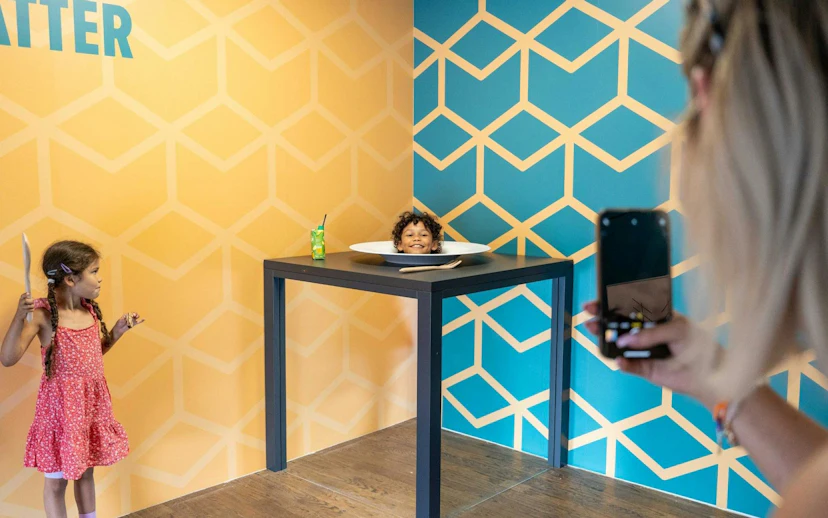
Head on a Platter and Cloning Table
Installation type: Interactive photo installations
These setups invite you to pose rather than simply view an exhibit. Check the framing before moving on; solo visitors can ask staff for photo help when staff are available.
Where to find it: Follow the installation signs along the self-guided route.
Smart Playroom
Activity type: Puzzles and brain teasers
The puzzle area gives you a slower activity after the photo rooms and can add around 30–60 minutes for visitors who want to try the games. It is a useful way to extend a quick visit, particularly with children or a group.
Where to find it: The Smart Playroom is part of the museum visit; follow signs toward the puzzles.
Facilities and accessibility
- 🎒 Bag storage: Large bags and umbrellas may be left at reception at the owner’s risk; small bags must be carried by hand or in front of you.
- 🚻 Accessible restroom: An accessible toilet is available inside the museum.
- 💳 Payment: The venue is cashless, so bring a payment card or use contactless payment.
- ♿ Mobility: The museum has a lift and most installations are wheelchair-accessible, but a few are not.
- 🧠 Cognitive and sensory needs: The Vortex Tunnel uses a rotating visual effect; you can move at your own pace and skip an effect that feels uncomfortable.
- 👨👩👧 Families and strollers: Strollers are allowed, though the operator does not publish details about access to every installation.
The self-guided format suits children who enjoy visual effects, posing, and puzzles; it keeps children engaged with you through the interactive rooms.
- 🕐 Time: Allow about an hour for the main route, with more time if your group wants to try the puzzles.
- 💡 Engagement: Ask children to guess how an illusion works before reading its explanation.
- 🎒 Logistics: Strollers are allowed, but large bags and umbrellas may need to be left at reception.
- 📍 After your visit: Choco-Story Brussels is a nearby option for another family-oriented indoor stop.
Rules and restrictions
What you need to know before you go
- Ticket and entry: Standard admission is self-guided; check that your booking name matches the Museum of Illusions Brussels at Rue du Fossé aux Loups 18.
- Bags: Small bags must be carried by hand or in front of you; large bags and umbrellas may be left at reception at your own risk.
Not allowed
- 🚫 Food and drink: Food and drinks are not allowed inside, except for bottled water.
- 🚬 Smoking and vaping: Smoking is not allowed inside the museum.
- 🐾 Pets: Small dogs are normally allowed only in a carrier.
- 🖐️ Exhibits: Follow the room instructions and use the marked positions so you can experience the effects as intended.
Photography
Personal photography is encouraged throughout the exhibits.
Good to know
- Address check: Brussels has another similarly named illusion attraction; confirm Rue du Fossé aux Loups 18 before travelling.
- Payment: The museum is cashless, so plan to pay by card or a contactless method.
Practical tips
- Booking and arrival: Book ahead during Belgian school holidays if you want to secure a time slot; a timed ticket does not guarantee immediate entry, so leave some flexibility around your arrival.
- Pacing: Follow the numbered displays, take photos in the perspective rooms while they are clear, and leave the Smart Playroom until last.
- Crowd management: Arriving close to 10am on a weekend gives you a better chance of reaching the photo installations before the midday crowding reported by visitors.
- What to bring or leave behind: Bring a phone or camera for the staged photo rooms, and avoid large bags and umbrellas because they may need to be left at reception at your own risk.
- Food and drink: Eat before or after your visit; food and drinks are not allowed inside, apart from bottled water.
- Photo help: If you are visiting solo, ask staff whether they can take a photo; visitors report that staff sometimes help with camera positioning and photographs.
- Check the address: Use Rue du Fossé aux Loups 18 when navigating; tickets for the similarly named attraction on Rue du Marché aux Fromages are for a different venue.
What else is worth visiting nearby?
Commonly paired: Grand-Place
Distance: About 530 m — around a 6-minute walk
Why people combine them: The museum makes a compact indoor stop before or after Brussels’ best-known central square, so you can add an interactive visit without setting aside a half-day.
Commonly paired: Choco-Story Brussels
Distance: About 650 m — around a 10-minute walk
Why people combine them: Pair the illusion rooms with a chocolate-focused visit for a family-friendly indoor itinerary with two different kinds of hands-on discovery.
Also nearby
Belgian Comic Art Museum
Distance: About 600–800 m — around a 10-minute walk
Worth knowing: It offers a more conventional museum visit centred on Belgian comic art, making it a different-paced follow-up to the interactive illusion rooms.
Belgian Beer World
Distance: About 500–700 m — around an 8-minute walk
Worth knowing: This adult-focused attraction offers a contrasting stop after the photo rooms and puzzles.
Half-day plan: Start at Museum of Illusions Brussels around opening and allow about an hour for the main route. Walk to Grand-Place afterward, then choose Choco-Story Brussels for a family-friendly indoor continuation or Belgian Comic Art Museum for a museum visit.
Eat, shop and stay near Museum of Illusions Brussels
- Belga Queen (Rue du Fossé aux Loups 32 – 1-minute walk): Right down the same street, housed in a converted 18th-century bank with a stunning stained-glass ceiling. Ideal for an upscale Belgian dinner, oysters, and local beer pairings.
- Chez Léon (Rue des Bouchers 18 – 6-minute walk): A Brussels institution operating since 1893, famous for moules-frites (mussels and fries) and a lively, family-friendly atmosphere.
- Aux Armes de Bruxelles (Rue des Bouchers 13 – 6-minute walk): A historic, white-tablecloth brasserie serving traditional Belgian staples like beef carbonnade, vol-au-vent, and shrimp croquettes.
- Le Café de l'Opéra (Place de la Monnaie 4 – 2-minute walk): Located directly across from the Royal Theatre of La Monnaie, offering classic brasserie fare and a large terrace great for people-watching.
Museum of Illusions Brussels is in central Brussels, close to De Brouckère and within walking distance of major central sights. It works well as a short visit during a city break, but the attraction’s location alone is not a reason to choose a hotel nearby.
- Best for: Visitors who want a short indoor activity close to central sightseeing.
- Consider instead: Choose your base around the rest of your Brussels itinerary and use public transport to reach the museum.
Frequently asked questions about visiting Museum of Illusions Brussels
Most visitors should allow about 60–90 minutes. A quicker visit can take around 45 minutes, while repeated photos and time in the Smart Playroom can extend it to 90–120 minutes.
Booking ahead is a practical choice during school holidays, when the museum recommends reserving online. A timed ticket reserves your visit but does not guarantee immediate entry or skip-the-line access.
Arrive close to your selected time and check in at the reception on Rue du Fossé aux Loups 18. Waiting times vary, so leave some flexibility, especially during school holidays.
Small bags must be carried by hand or in front of you. Large bags and umbrellas may be left at reception at your own risk, so travel light if you do not want to leave belongings behind.
Yes, personal photography is encouraged throughout the exhibits. Staff may be able to help with camera angles or take a photo, but check with them before using tripods, flash, or professional filming equipment.
Yes, standard admission is self-guided, and groups can visit the public route. Organised school or private groups can enquire about guided visits; confirm group arrangements with the venue before planning your visit.
Yes, children can take part in the perspective rooms, photo installations, and puzzles. Strollers are allowed, and the self-guided format lets your group move at its own pace.
A lift and an accessible toilet are available, and most installations are wheelchair-accessible. A few installations are not accessible.
There is no café inside the museum, and food and drinks are not allowed in the exhibits, except for bottled water. You can plan a meal before or after your visit in central Brussels.
Museum of Illusions Brussels is at 18 Rue du Fossé aux Loups. Check this address before paying, because another similarly named attraction in Brussels is at a different location, and its tickets are not interchangeable.